
Industrial activity virtually disappeared during the twentieth century, but the domestic recipe and the memory of the former factories were not lost. Anchovies associated with Cadaqués are still produced and sold today, and several restaurants in the municipality continue to include them on their menus.
Main idea: the local distinctiveness lies less in the way the anchovies are served—which is shared with many parts of Catalonia—and more in the historical salt-curing tradition and the use of black pepper during the curing process.
Fishing and salt curing in old Cadaqués
The economy of Cadaqués was closely linked to the sea. The old fishing regulations governed the use of the coves and the organisation of fishing, allocating spaces and shifts among the fishermen. This communal system helped organise an activity that was essential to the village’s survival.
Between the nineteenth and early twentieth centuries, factories were established to prepare anchovies, tuna and other food products. Salt-cured products were particularly valuable because they made it possible to preserve fish without refrigeration and ship it by sea to other Mediterranean and American markets.
Work in the factories
Preparing the anchovies involved cleaning the fish, placing it in salt, arranging it carefully inside containers and monitoring the maturation process. A significant part of this work was carried out by women, meaning that salt curing also formed part of the history of women’s employment in Cadaqués.
The factories had large containers, barrels and working areas where the catch was handled. In addition to preserving the fish, some companies manufactured or prepared the barrels used to press and transport it.
Casa Pont and the former anchovy industry
One of the most prominent historic companies was Casa Pont. Gastronomic sources from Girona associate it with one of the first major anchovy factories on the Costa Brava and state that the Cadaqués facility reached a considerable size within the industry.
Preparing the fish in barrels allowed it to be pressed and kept in salt during maturation. Thanks to this method, the anchovies could withstand long journeys and be sold beyond the local area.
The decline of the traditional activity
During the second half of the twentieth century, tourism, changes in fishing, the modernisation of the food industry and the economic transformation of the coastline led to the closure of most of Cadaqués’s salt-curing factories. The activity remained stronger in other towns, particularly l’Escala.
In Cadaqués, however, many households continued to prepare anchovies as a family recipe. This domestic transmission explains why a distinctive local method of curing them is still recognised today.
What characterises Cadaqués anchovies
Salt-cured anchovies are made from fresh anchovies, known locally as seitó and in Spanish as boquerón. After being cleaned and subjected to a prolonged curing process with salt, the fish develops a firm yet tender texture, a copper or mahogany colour and an intense marine flavour.
The most frequently cited feature of the Cadaqués tradition is the addition of black pepper between the layers of fish. Some family recipes also mention small amounts of thyme or fennel, although there is no single fixed formula: each household could introduce slight variations.
Summary of the traditional process
- Fresh anchovies are selected and their heads and entrails are removed.
- The fish is covered with coarse salt to draw out moisture.
- The anchovies are arranged in layers or in a spiral inside a container.
- Salt and black pepper are added between the layers.
- The fish is kept covered by the brine that forms during the process.
- The container is stored in a cool, dark place.
- Maturation may take six months, one year or longer, depending on the recipe and the desired result.
Local vocabulary: in the traditional speech of Cadaqués, the word roellada has been used to describe an anchovy that has aged too much or become excessively oxidised after being left in the salt cure for a prolonged period.
Are they still produced and sold?
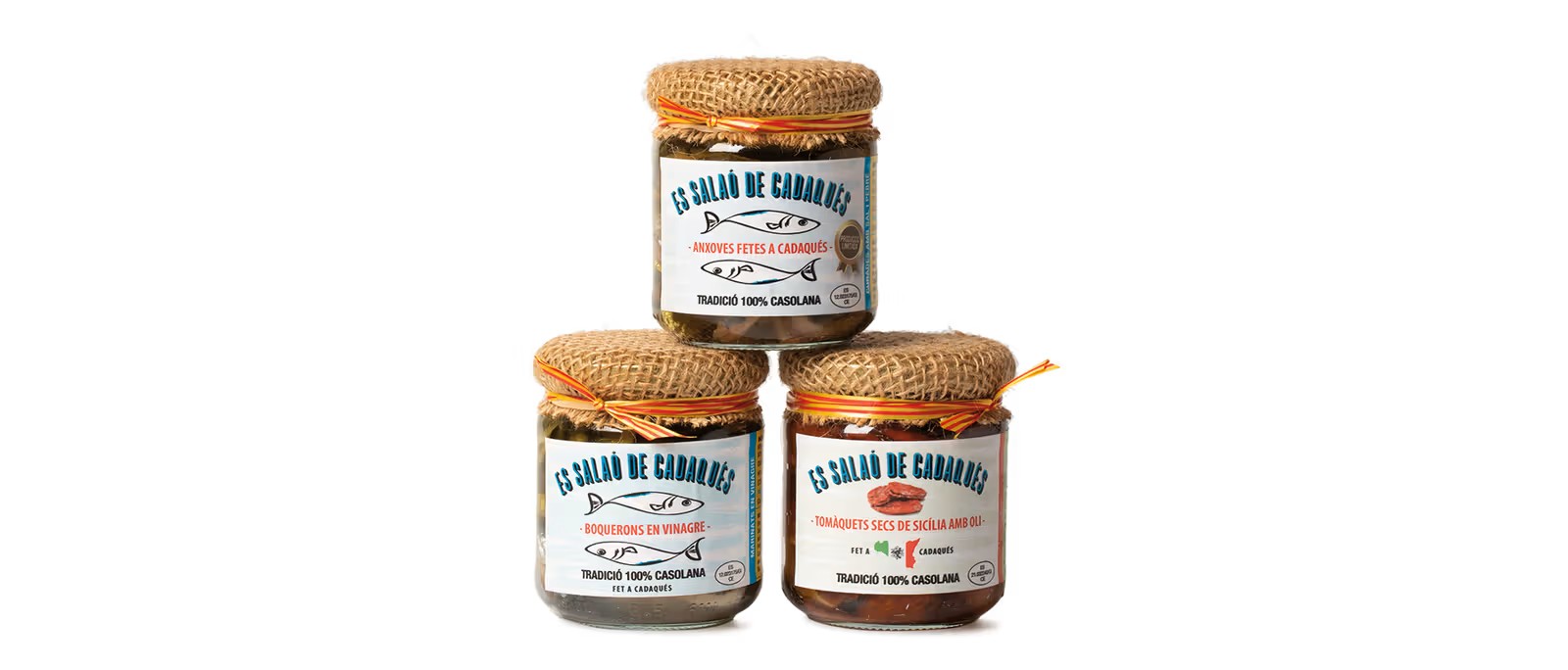
Yes. Present-day production is artisanal and much smaller than the former salt-curing industry, but the tradition remains alive. During research carried out in July 2026, Es Salaó de Cadaqués appeared in Catalonia’s official agri-food register as a company engaged in the handling, drying and salt curing of fish.
The producer describes its anchovies as being cured for approximately one year with salt and black pepper. Vinegar-marinated anchovies and other prepared products are also sold.
Sales and enquiry points
| EstablishmentLocationTelephoneInformation | |||
| Es Salaó de Cadaqués | Carrer Portlligat, 71, 1r 1a, Cadaqués | 669 557 050 | Local producer. The registered address may correspond to the production premises rather than a shop that is permanently open. Calling in advance is advisable. |
| Carnisseria Serraplà | Sa Riera, s/n, and carrer Doctor Callís, 12, Cadaqués | 972 15 92 95 / 972 25 83 40 | Has sold the well-known Anxoves de la Quimeta. It is advisable to confirm availability. |
| Cooperativa Agrícola de Garriguella | Garriguella and online shop | Enquire with the cooperative | Has offered a product called Anchoas de Cadaqués, cured with salt and black pepper. Availability may vary. |
Where to find them in restaurants
Menus change according to the season and product availability. During the July 2026 research, the following establishments listed Cadaqués anchovies or dishes prepared with anchovies on their menus or websites.
| Restaurant | Location | Telephone | Published presentation |
| Sa Cadaquesenca | Carrer Trilla, 7 | 972 15 91 18 | Anchovies with pan de cristal and house-made oil. |
| Sa Gambina | Riba Nemesi Llorens, s/n | 972 25 81 27 | A serving of anchovies as a starter to share. |
| Cadaq’s | El Passeig, 3 | 628 06 64 39 | An assortment of salt-cured and vinegar-marinated anchovies served with olives. |
| La Gritta | Passeig, 11 / Es Pianc, 9 | 972 15 94 71 / 872 20 94 73 | Cadaqués anchovies served as a starter. |
| Orsapop | Carrer Hort d’en Sanés, 1 | Enquire when booking | Anchovies included in a contemporary Mediterranean menu. |
| Sa Roca d’es Tamariu | Pujada des Pianc, 2 | 972 25 90 02 | Cadaqués anchovies among its classic tapas. |
Flavour, texture and storage
A properly cured anchovy usually has a copper or mahogany colour, a firm yet tender texture and an intense, salty and slightly iodine-like flavour. In the preparation associated with Cadaqués, black pepper contributes a warm, spicy aroma that helps distinguish it from other Mediterranean preparations.
Anchovy fillets preserved in oil are a semi-preserved product and must be kept refrigerated. The storage temperature, use-by date and instructions on the packaging must always be followed. When transporting them, particularly in summer, it is advisable to use an insulated bag and place them in a refrigerator as soon as possible.
Typical ways of serving and eating them
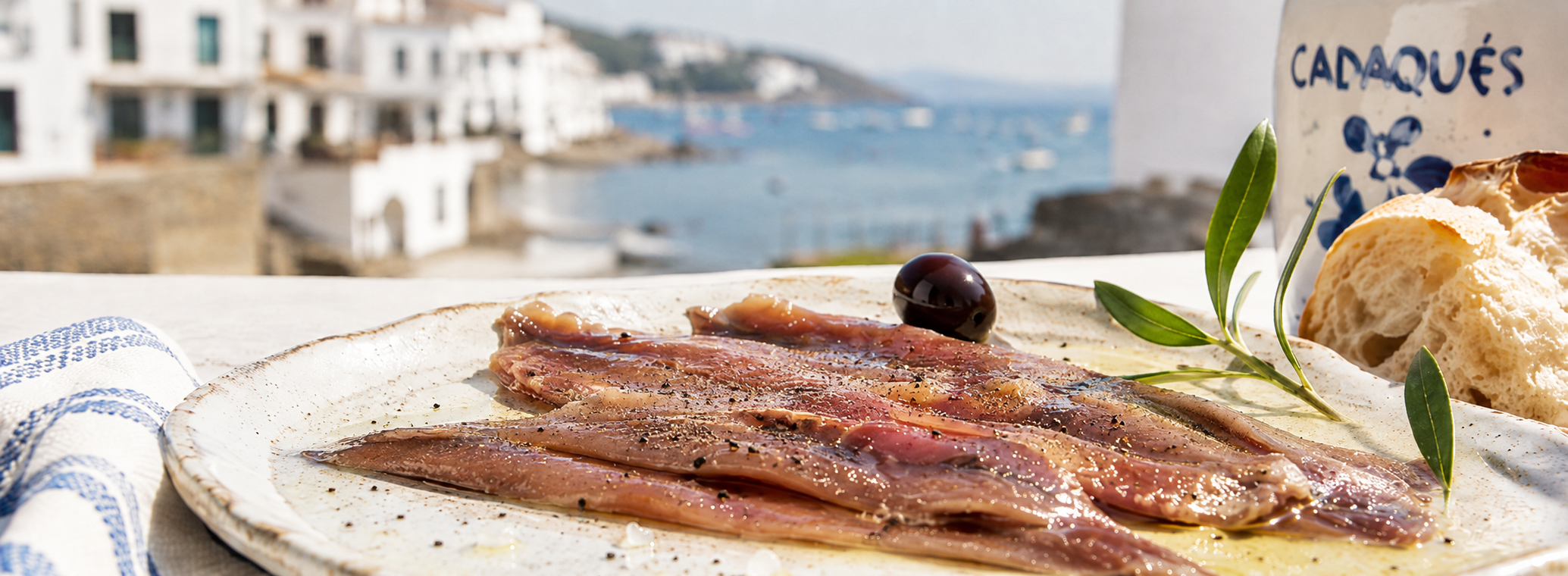
The way anchovies are served in Cadaqués is similar to the customary presentation found elsewhere in Catalonia. They are eaten as an appetiser or starter, usually cleaned and covered with a small amount of olive oil.
- On tomato-rubbed bread, coca bread or toast.
- With ripe tomato and extra virgin olive oil.
- Accompanied by olives.
- Combined with vinegar-marinated anchovies.
- Served as a simple portion to share.
There is usually no need to add salt or much pepper when serving them, as the curing process already provides considerable intensity and seasoning.
Conclusion
The anchovies of Cadaqués bear witness to the municipality’s maritime past. They formed part of its fishing activity, domestic economy, factory work and maritime trade. Although the large-scale industry disappeared, the recipe based on salt, time and black pepper survived within local families and can now once again be found in small-scale production, shops and restaurants.