
Between the sea and a difficult land
Seen from the sea, Cadaqués appears to belong entirely to the maritime world: boats, white houses, fishermen and small coves. Yet for centuries its inhabitants did not live from the sea alone. They also had to conquer rugged, dry and stony land in order to grow vines and olive trees.
Cadaqués’s geographical isolation, separated from the Empordà plain by Mount Pení, forced its inhabitants to combine different means of subsistence. They fished, sailed and traded, but they also cultivated anything that could adapt to the wind, scarce water and poor soils.
A document from 1030 already mentions the presence of vineyards, fishermen, ports and coves on the Cap de Creus peninsula. It does not reveal when systematic olive cultivation began, but it shows that agriculture had formed part of local life since the Middle Ages.
The olive tree was especially well suited to this territory: it withstands drought, takes root in shallow soils and tolerates harsh Mediterranean conditions. Even so, planting it on the slopes of Cadaqués required an enormous amount of work.
The civilisation of dry-stone walls
The mountains offered no flat surfaces for cultivation. To create them, generations of cadaquesencs built kilometres of walls from pieces of local slate, laid one on top of another without cement or mortar.
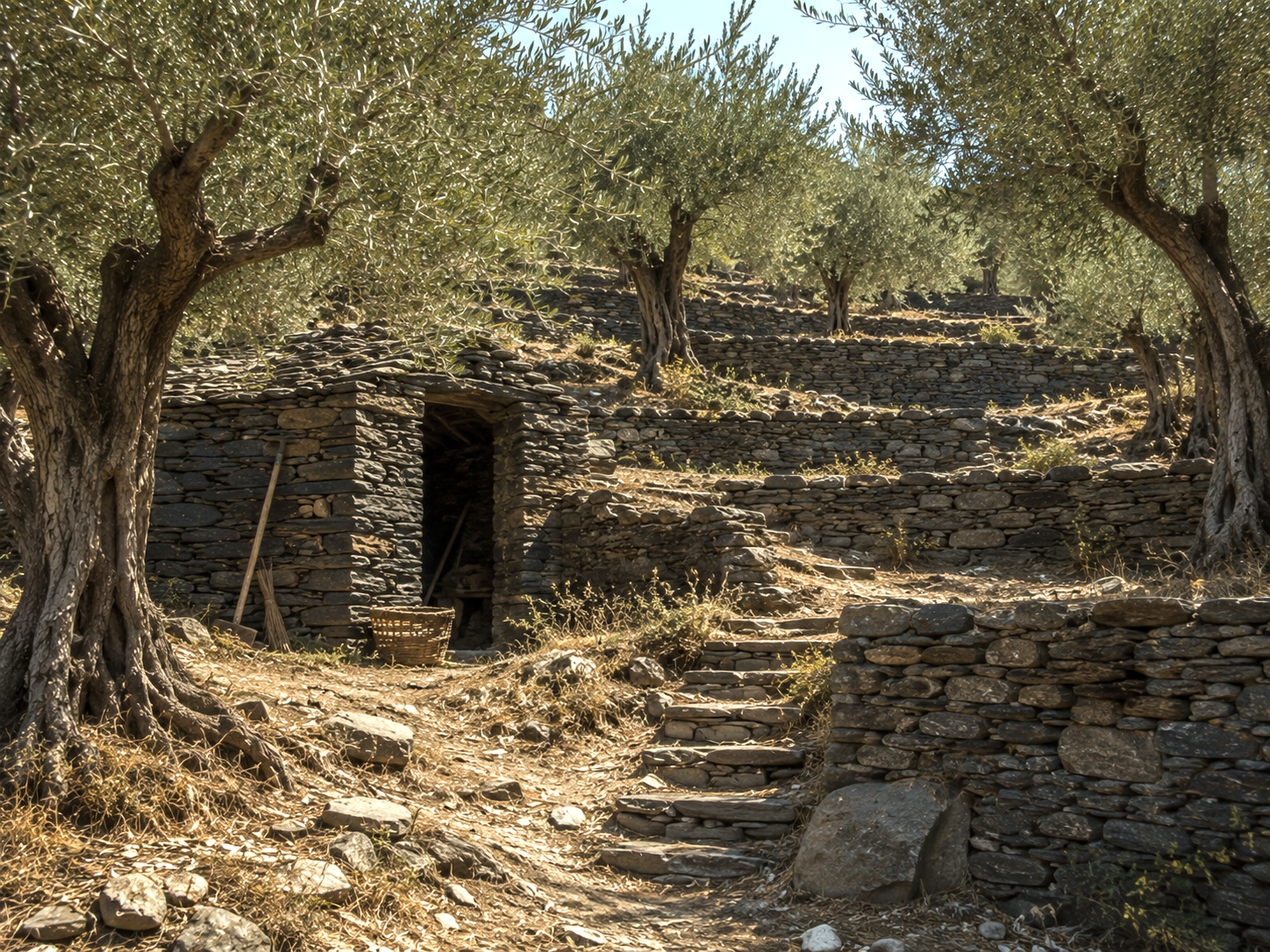
These walls formed the feixes, or agricultural terraces, also known as travesseres in the local speech. They retained fertile soil, slowed erosion, channelled water and created small surfaces on which vines and olive trees could be planted.
Beside the terraces, people built huts for storing tools and taking shelter, as well as steps, water cisterns, wells, paths and clopers — piles made from the stones left over. The result was a complete rural architecture, constructed almost entirely from stone taken from the land itself.
Josep Pla called this system the “civilisation of dry-stone walls”. The territory we now see as a natural landscape was, for centuries, a collective construction made stone by stone.
First the vineyards, then the olive trees
For much of the eighteenth and nineteenth centuries, viticulture was, alongside fishing, one of the fundamental economic activities of Cadaqués. Many of the terraces we now associate with olive trees were originally built for planting vines.
The situation changed with the arrival of phylloxera. The pest entered Catalonia through the Alt Empordà in 1879 and reached Cadaqués around 1883, destroying a large proportion of the vineyards. The blow was particularly severe because cultivating those slopes required enormous effort and yielded limited returns.
Some vineyards were replanted, but other terraces were planted with olive trees, which were hardier and longer-lived. The olivassos — a Cadaqués term for an olive grove or a place planted with olive trees — spread across former vineyard land.
Olive trees did not completely replace the vine, but during the first half of the twentieth century they became an essential part of Cadaqués’s agricultural landscape.
A scarce and highly prized oil
Cultivation was not intended solely for family consumption. During the nineteenth century, Cadaqués had activities connected with olive-oil production, alongside factories producing salted fish, spirits, vinegar and soap.
Oral tradition recalls that there were once as many as four trulls, or olive mills, in the village. During the harvest, families took their olives there and waited while they were crushed and pressed. The winter cold, the smell of olive paste and the preparation of allioli all formed part of the same communal scene. Today, no active olive mill remains within Cadaqués.
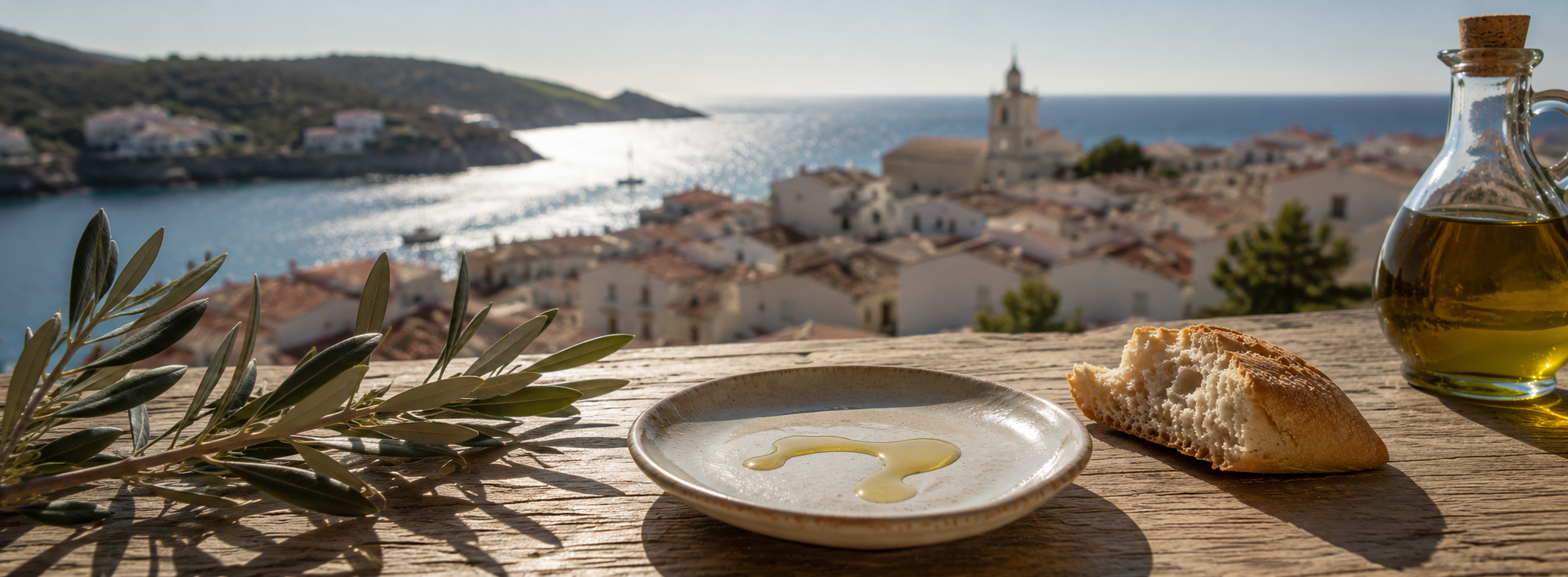
The local oil acquired a notable reputation. Josep Pla considered it one of the finest in the country. Its character was attributed to the difficult conditions in which the trees grew: little soil, wind, drought and cold. These circumstances reduced the quantity of olives but could concentrate their flavour.
The “llei de Cadaqués”
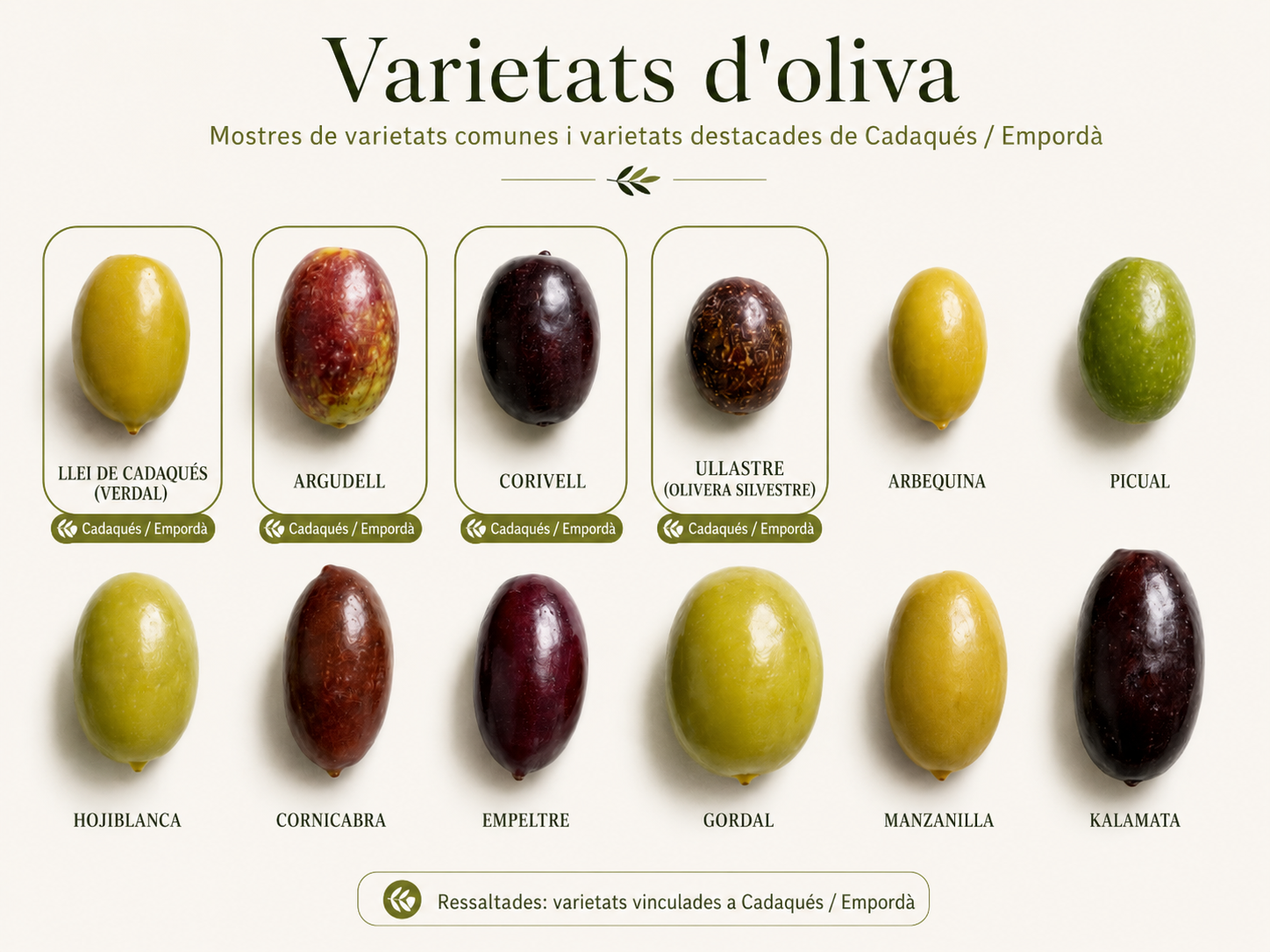
Among the cultivated varieties, the verdal stands out, also known as the llei de Cadaqués. It is a traditional variety closely linked to Cadaqués and El Port de la Selva and is recognised under the Oli de l’Empordà Protected Designation of Origin.
Alongside it are Empordà varieties such as argudell and corivell, as well as olive trees grown or grafted onto ullastres, the wild olive trees native to the area.
The expression llei de Cadaqués gives the tree a particularly local identity. It is not simply an olive tree cultivated in the municipality, but a variety whose very name preserves the memory of the land.
The dolls and the transport of oil
Olive oil was present in everyday life in ways that may now seem surprising. The well-known dolls of Cadaqués, usually associated with carrying water, could also be used to transport oil.
Women carried these large green vessels on their heads. When empty, they could be held at a slight angle; when filled with water or oil, they had to be kept upright. Old photographs preserve evidence of this custom.
The doll, the olive trees, allioli, the mills and the dry-stone walls all belonged to the same domestic and agricultural system. Oil was not merely an ingredient: it was the result of family labour and an important part of the local economy.
The great freeze of 1956
The event that permanently changed the olive groves of Cadaqués was the extraordinary cold wave of February 1956.
Temperatures fell sharply, and many branches and trunks split as the sap froze. Numerous olive trees died or were so badly damaged that they had to be cut down. The olivassos that covered the old terraces became far less prominent in the landscape.
The freeze dealt a decisive blow, but it was not the only cause of abandonment. Traditional agriculture was already in crisis: working narrow terraces by hand was costly, mechanisation was almost impossible, and many young people sought more stable employment.
At the same time, tourism and construction began to offer new economic opportunities. The old olive groves gradually became overgrown with scrub and spontaneous vegetation.
An abandoned landscape that did not disappear
Although many olive trees were no longer cultivated, the structures of the landscape remained. The walls continued to draw horizontal lines across the mountains, and many trees sprouted again from their roots or survived among the vegetation.
In many places the former agricultural organisation can still be recognised: stepped terraces, stone-lined paths, huts, twisted olive trees and plots overtaken by undergrowth. The surroundings may appear natural, but everywhere they retain the traces of human labour.
Abandonment also had environmental consequences. Without maintenance, some walls collapse, soil accumulated over generations is lost, and continuous scrub cover increases, encouraging the spread of wildfires.
Restoring the olive trees means restoring the landscape
In recent decades, there has been a modest revival of vine and olive cultivation in Cap de Creus. Agricultural terraces and dry-stone construction are recognised as among the area’s foremost historical and landscape values.
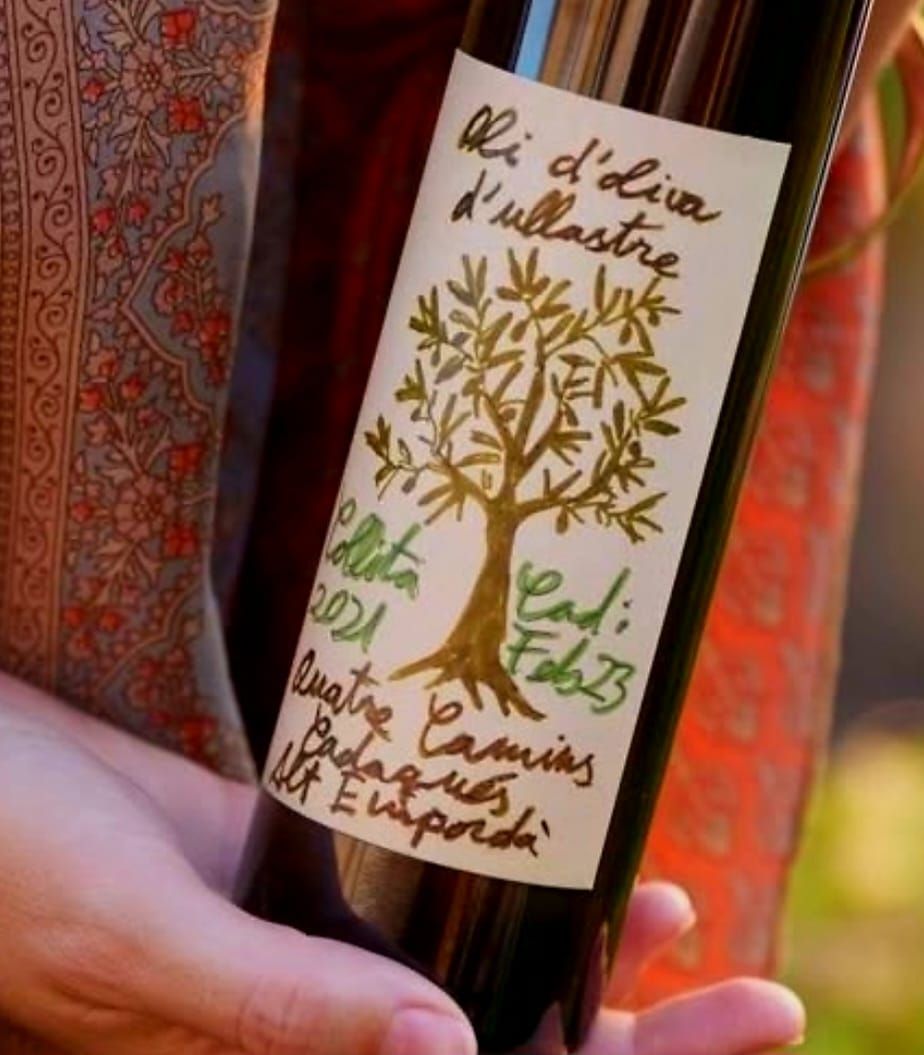
This revival is not intended to restore mass production. Farming in Cadaqués remains difficult and poorly suited to mechanisation. Its value lies in preserving local varieties, maintaining walls and paths, reducing fire risk, restoring small-scale olive-oil production and passing on agricultural knowledge that was disappearing.
The oil produced remains scarce and closely tied to local consumption, but it has regained interest as a product with an identity of its own.
Olive trees through the artists’ eyes
Olive groves and dry-stone walls are also part of the Cadaqués observed by writers and painters. Josep Pla saw in them the patient effort of entire generations. Salvador Dalí included paths, terraces and slate walls in many of his early landscapes, as inseparable elements of the surroundings of Portlligat.
They were not merely decorative elements. Those lines of stone brought order and scale to a rugged territory. The olive trees added the grey-green tone that linked the white houses with the darkness of the slate and the blue of the sea.
This chromatic relationship can be interpreted as part of Cadaqués’s popular aesthetic sensibility. It does not prove that the green of the shutters or the dolls came from the olive trees, but it shows how the village developed its own palette: lime white, dark green, stone grey and Mediterranean blue.
The agricultural memory of Cadaqués
Cadaqués today is deeply associated with the sea and art, but behind the village another Cadaqués still exists: that of the families who raised walls stone by stone, planted vines, tended olive trees and carried water and oil in large ceramic vessels.
The olive trees explain how a community survived on difficult land. They also help us understand why the landscape of Cadaqués is so different from that of other coastal villages. The mountains that now appear wild were not always abandoned; they were a collective construction, cultivated and ordered for centuries.
For this reason, restoring an olive tree or rebuilding a dry-stone wall does not simply mean preserving a tree or repairing a wall. It means keeping an essential part of the history of Cadaqués visible.