
Before becoming one of the best-known towns on the Costa Brava, Cadaqués already possessed what so many artists were seeking: a changing light, a mineral landscape hard to find elsewhere, a sheltered bay and a daily life marked by the sea. Its prolonged isolation by land also helped preserve its own architecture, customs and personality.
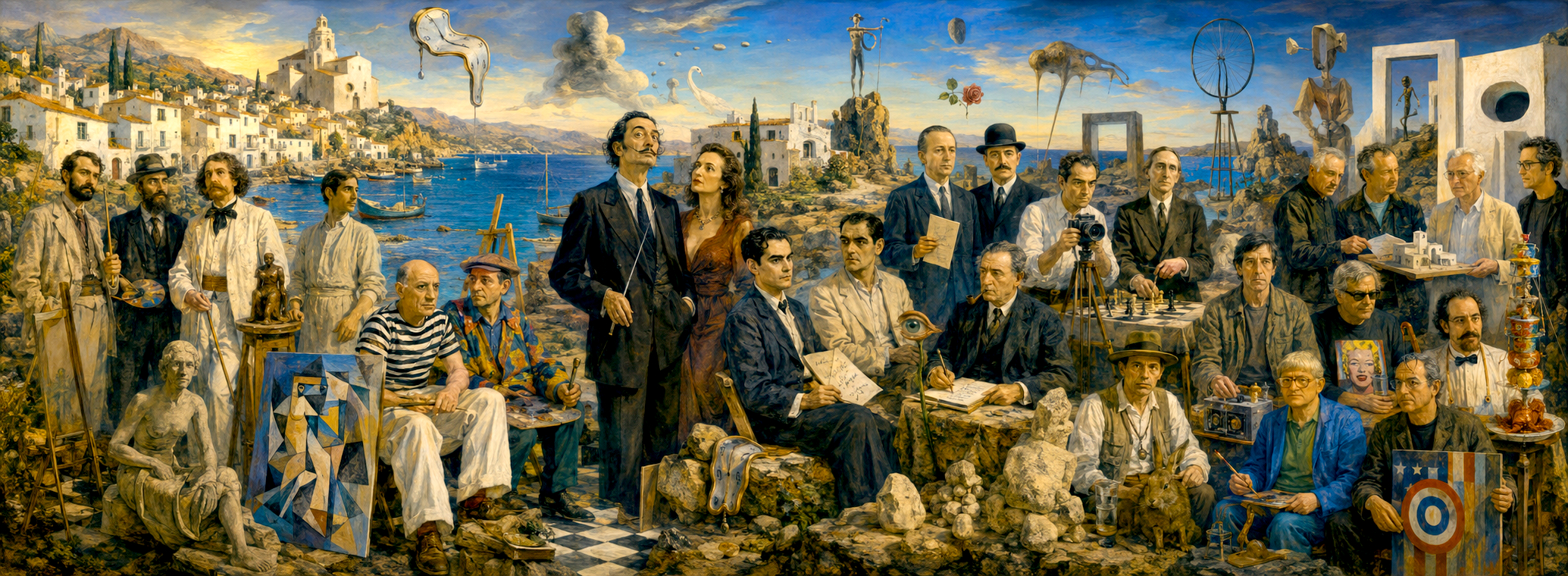
There is no complete record of all the art-related figures who passed through Cadaqués. Some stayed for decades; others made brief visits that left an unexpected mark. This selection brings together the most relevant and best-documented figures, avoiding turning the town's cultural history into a mere accumulation of names.
Cadaqués was not merely a beautiful backdrop visited by famous people. The town played an active part in that history. Some artists came to work, but many others arrived seeking peace, freedom or a way of life far from the obligations of Paris, Barcelona, London or New York. Although they may not have initially intended to create, the landscape and the shared experience ended up entering their work.
Eliseu Meifrén: Cadaqués before the avant-garde
One of the first great modern painters to maintain an ongoing relationship with Cadaqués was Eliseu Meifrén. In 1886 he moved to the town with his family and later bought a house in Portlligat, where he spent long periods until a few years before his death.
Meifrén painted numerous seascapes and views of Cadaqués. His importance lies in having understood the landscape as an artistic subject in its own right long before the town's name became associated with Surrealism. In his paintings, the sea, the white houses and the changing atmosphere are not a backdrop but the true subject of the work.
The Pichot family and the first artistic circle
Between the end of the 19th century and the beginning of the 20th, the Pichot family turned their house in Es Sortell into a unique meeting place. Ramon Pichot was a painter, while several of his siblings were involved with music and opera. In that house, painting, concerts, conversations, meals and coastal excursions all came together.
The atmosphere lacked the formal character of an academy. It was a form of culture lived within the home and shared with guests. The Pichots' gatherings were attended by prominent figures of Modernisme, including Santiago Rusiñol and the sculptor Manolo Hugué, for whom those meetings formed part of his earliest artistic milieu.
Ramon Pichot's influence proved especially important for the young Salvador Dalí. It was through his paintings that Dalí discovered Impressionism, visible in many of the landscapes and seascapes he produced during his early period.
1904: Eugeni d'Ors and Lídia de Cadaqués
In 1904, the writer and philosopher Eugeni d'Ors made a brief stay in Cadaqués, lodging at the home of Lídia Noguer, a fishwife who took in guests.
That encounter had an unusual consequence. Lídia developed an intense fascination for the writer and, when d'Ors published La ben plantada in 1911, she came to identify herself with Teresa, the book's protagonist. She also interpreted the author's newspaper articles as personal messages directed at her.
Her personality later impressed Dalí, Lorca and Buñuel. Years afterwards, d'Ors reconstructed her story in a book illustrated by Salvador Dalí. A brief visit ended up forming part of Cadaqués' cultural mythology.
1910: Picasso and the geometry of the landscape
In the summer of 1910, Pablo Picasso arrived in Cadaqués accompanied by Fernande Olivier and his friend Ramon Pichot. There he coincided with the French painter André Derain and met again with Eugeni d'Ors.
The stay occurred at a decisive moment in his Cubist research. The stepped houses, the mountains and the rocky forms of the surroundings appeared in his paintings transformed into geometric planes and volumes. The landscape of Cadaqués seemed to offer him a natural structure that he could break down and rebuild through painting.
The Museu Picasso considers that summer a key experience in the development of his work. Cadaqués does not appear in those paintings as a picturesque town, but as a mineral architecture reduced to essential forms.
Salvador Dalí: a landscape turned into an inner world
Although Salvador Dalí was born in Figueres, Cadaqués was the fundamental landscape of his childhood and his artistic training. During the summers he painted his family, the bay, the boats, the houses and the surrounding paths. Long before becoming a Surrealist, he had already developed a deep relationship with that territory.
In 1930, Dalí settled with Gala in a small fisherman's hut in Portlligat, a building of barely twenty-two square metres with no electricity. Over the following forty years they gradually acquired and connected other huts until they formed a labyrinthine, organic and utterly personal house.
Portlligat became a residence, workshop and observatory. The light, the rocks and the horizon of Cap de Creus appear repeatedly in his work, sometimes recognisable and at other times transformed into figures, bodies or imaginary spaces. Dalí did not use Cadaqués as a backdrop: he turned its geography into a part of his artistic language.
Federico García Lorca: poetry facing the sea
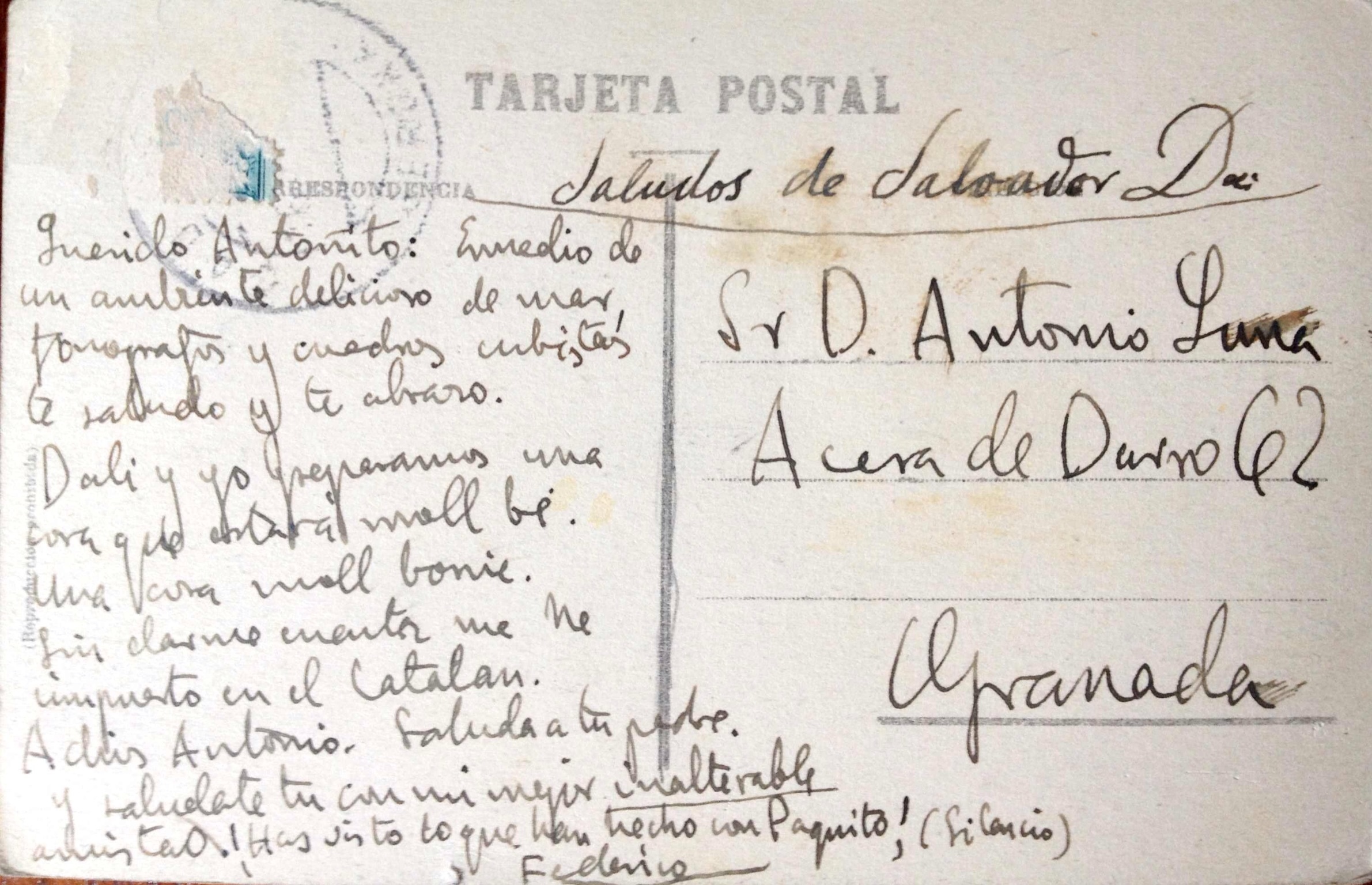
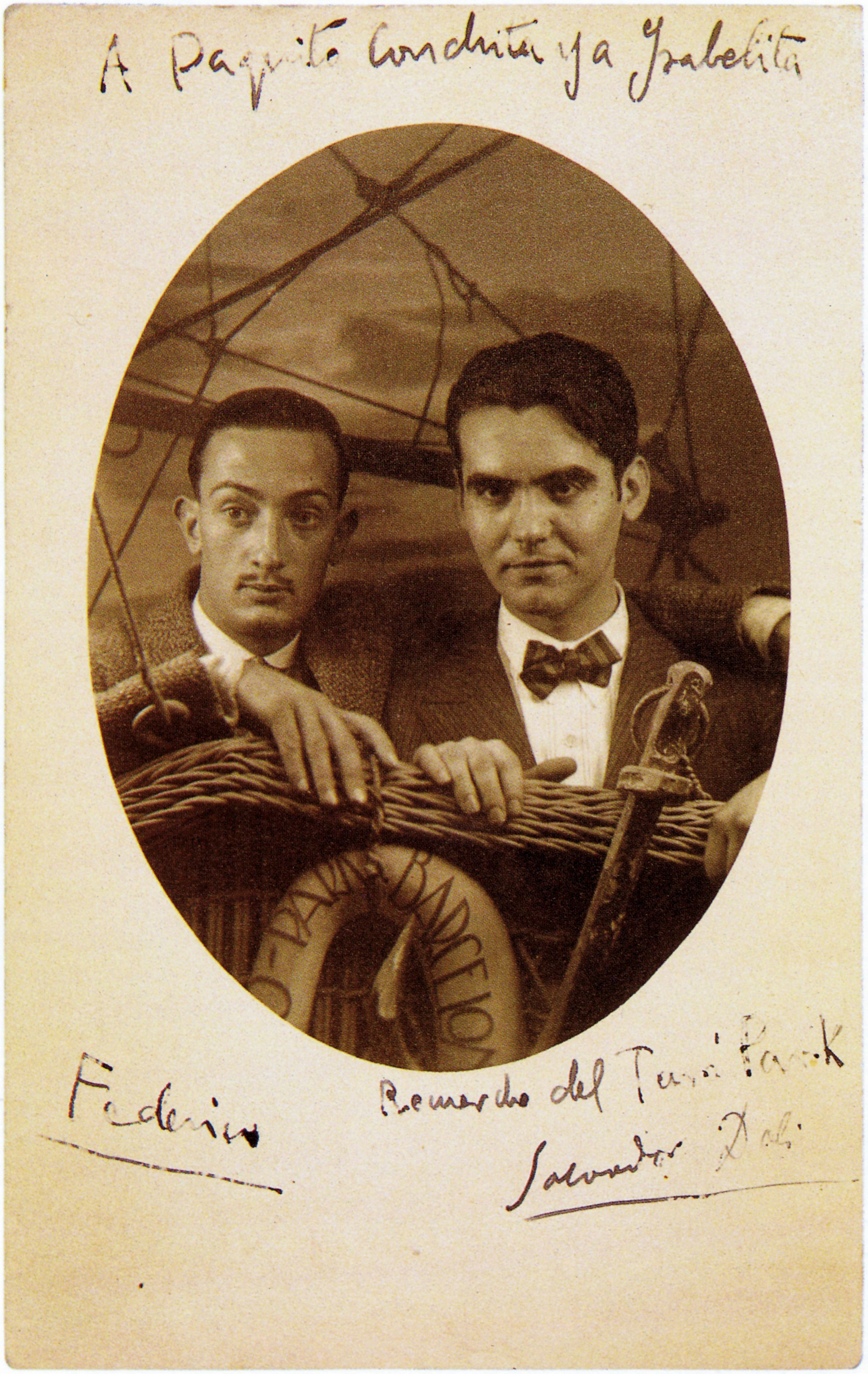
Federico García Lorca visited Cadaqués in April 1925, invited by the Dalí family. During his stay he read Mariana Pineda aloud to them, a play he had just finished, and later read it again at the notary office of Dalí's father in Figueres.
The time spent together by Lorca and Dalí was both artistic and personal. They talked, drew, walked and shared projects. After that first stay, Lorca began working on the Ode to Salvador Dalí. He returned to the town in 1927, coinciding with the preparations for the premiere of Mariana Pineda, whose sets had been commissioned from the painter.
The photographs taken during those summers show both of them by the sea, still young and far removed from the solemnity with which they would later be regarded.
Luis Buñuel: Surrealism written in Cadaqués
In the late 1920s, Luis Buñuel spent an intense week in Cadaqués working with Dalí. From that collaboration came the project for Un chien andalou, one of the key films of Surrealist cinema.
They both decided to construct the script avoiding any rational explanation of the images. Dreams, unexpected associations and visual impact replaced conventional narrative. Cadaqués' isolation provided the right space to develop that way of working.
Buñuel returned in 1930 during the shooting of L'âge d'or. During those days he also filmed Menjant garotes, a short home movie in which Dalí's father and aunt appear eating sea urchins in the family home. The scene retains something particularly redolent of Cadaqués: an everyday activity transformed, almost unintentionally, into an artistic document.
The summer of 1929: Gala, Éluard and Magritte
In August 1929, a group linked to Parisian Surrealism arrived in Cadaqués. It consisted of the poet Paul Éluard, his wife Gala, their daughter Cécile, the painter René Magritte, Georgette Magritte and the writer and gallery owner Camille Goemans.
The visit definitively changed the lives of Dalí and Gala. During those days the relationship between them began. Gala remained with the painter and over time became his companion, manager, collaborator and principal driving force.
The encounter took place among the rocks, paths and coves of Cadaqués. One of the most decisive episodes in Dalí's biography did not occur in a Paris gallery, but during a summer in a small fishing village.
Josep Pla: the human landscape
In 1946, Josep Pla lived in Cadaqués and wrote there, between 1946 and 1947, the book he dedicated to the town.
His gaze was different from that of the painters and Surrealists. Pla observed the weather, fishing, food, conversations, the character of the locals and the relationship between the landscape and daily life. Instead of turning Cadaqués into a fantasy, he tried to understand how that territory had shaped its inhabitants.
His book constitutes one of the most important descriptions of Cadaqués before the tourist expansion.
Man Ray and Marcel Duchamp: a second avant-garde
During the middle decades of the 20th century, Cadaqués welcomed a new international generation. Man Ray spent considerable periods in the town, although it was Marcel Duchamp who established a more sustained relationship with local life.
From the 1950s until his death in 1968, Duchamp spent approximately three months each summer in Cadaqués. He did not come seeking recognition or public activity. He presented himself as a respirateur: someone who wanted to breathe, think and remain apart from the obligations of the art world.
In the town he was known above all as a chess player. Every afternoon he would go down to Bar Melitón to find opponents among the locals and fishermen. However, Cadaqués also ended up physically entering his work: an old door found in the surrounding area was sent to New York and incorporated into his secret installation Étant donnés.
John Cage, Richard Hamilton and art as play
Duchamp's presence attracted other artists. From the early 1960s, the composer John Cage and the British artist Richard Hamilton travelled to Cadaqués several times.
Cage came to visit Duchamp and play chess with him, although the master's superiority meant many games ended up being played against his wife, Teeny. The tranquillity of the town suited his interest in chance, silence and everyday events particularly well.
Hamilton ended up buying a house. He sailed, rested and developed ideas that he later continued in England. He considered Cadaqués a kind of laboratory. There he began works and carried out joint projects with the Swiss artist Dieter Roth, demonstrating that the town no longer inspired only landscapes: it could also generate experimentation, humour and conceptual art.
Antoni Pitxot and the stones of Cap de Creus
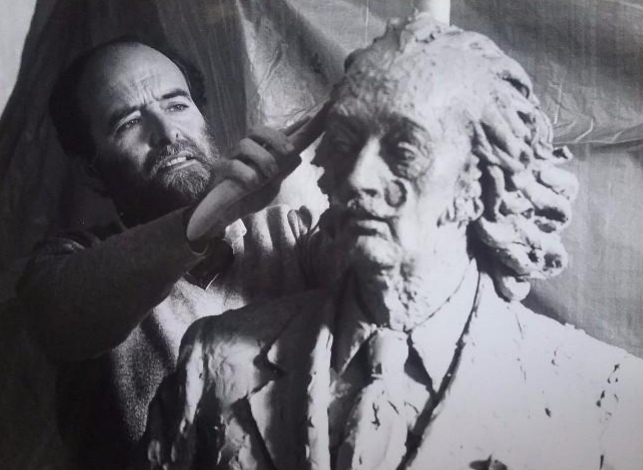
During the 1960s, Antoni Pitxot settled permanently in Cadaqués. A member of the Pichot family, he became one of Dalí's closest collaborators.
The mineral landscape of Cap de Creus profoundly conditioned his painting. Pitxot would collect and arrange stones until he discovered faces, figures and mythological scenes in them, which he then transferred to the canvas. In his works, stone does not simply represent the landscape: it becomes a character.
His painting demonstrates the extent to which the geology of Cadaqués could become a method of creation.
Bombelli, Harnden and the Galeria Cadaqués
In the early 1960s, the architects Peter Harnden and Lanfranco Bombelli chose Barcelona and Cadaqués as their working bases. They built modern homes respecting the scale, white volumes and sobriety of local architecture.
In 1973, after Harnden's death, Bombelli put together a folder of silkscreen prints to raise funds to prepare the part of the cemetery where his friend was to be buried. He set up the exhibition in the warehouse of an old salting factory. The initiative was so successful that this improvised space became the Galeria Cadaqués.
The gallery brought works by Duchamp, Hamilton, John Cage, Joseph Beuys, David Hockney, Jasper Johns and Dieter Roth to the town, among others. Not all of them necessarily resided in or visited Cadaqués, but their works found there one of the first Spanish spaces open to the international avant-gardes.
It also hosted experiences that went beyond the traditional exhibition format. Antoni Muntadas developed Cadaqués Canal Local, a pioneering community television experiment in which the locals became both protagonists and spectators. Antoni Miralda brought participatory actions to the town in which art, festivity and daily life merged.
A place where art could be part of life
The artistic history of Cadaqués cannot be explained solely as a succession of illustrious visitors. The town offered something that the big cities could not easily provide: isolation without loneliness, freedom without a programme and direct coexistence between artists, fishermen, locals and holidaymakers.
The creators did not always come with the intention of producing a work. They came to sail, talk, play chess, eat sea urchins, walk among the rocks or contemplate the sea. Yet it was precisely this absence of obligations that allowed new ideas to emerge.
Cadaqués moved from Meifrén's landscape painting to the Modernisme of the Pichots; from Picasso's Cubism to Dalí's universe; from Lorca's poetry to Buñuel's cinema; from Duchamp's chess to Cage's experimental music and Muntadas' participatory actions.
The extraordinary thing is that all these currents were able to coexist without erasing the town's identity. Each artist found a different Cadaqués, but none managed to exhaust it. The place remained recognisable and, at the same time, capable of transforming itself into painting, poetry, cinema, architecture, music and experimentation.
For this reason, Cadaqués should not be understood merely as a town frequented by artists. It was —and continues to be— a landscape capable of changing the way those who come to it see the world.