Why ants?
The ant is one of the recurring images of Dalí's universe.
From a very young age Dalí associated them with very intense impressions. In his memories they appear linked to decomposition, death and the transformation of matter, and this image would end up entering his painting and his surrealist language.
We find them in fundamental works by Dalí and also in Un Chien Andalou (1929), the film made with Luis Buñuel, in the famous image of a hand from which ants emerge.
But there is an even more beautiful connection with Cadaqués: Anna Maria Dalí, the painter's sister, remembered the winged ants that appeared at dusk on the beaches of Cadaqués. The ant therefore does not belong solely to Dalí's surrealist imagery; it is also tied to the landscape and to the memories of his childhood.
Dalí would even go so far as to state:
"I have come to the certainty that the ant is a superior being."
What do the plaques mean?
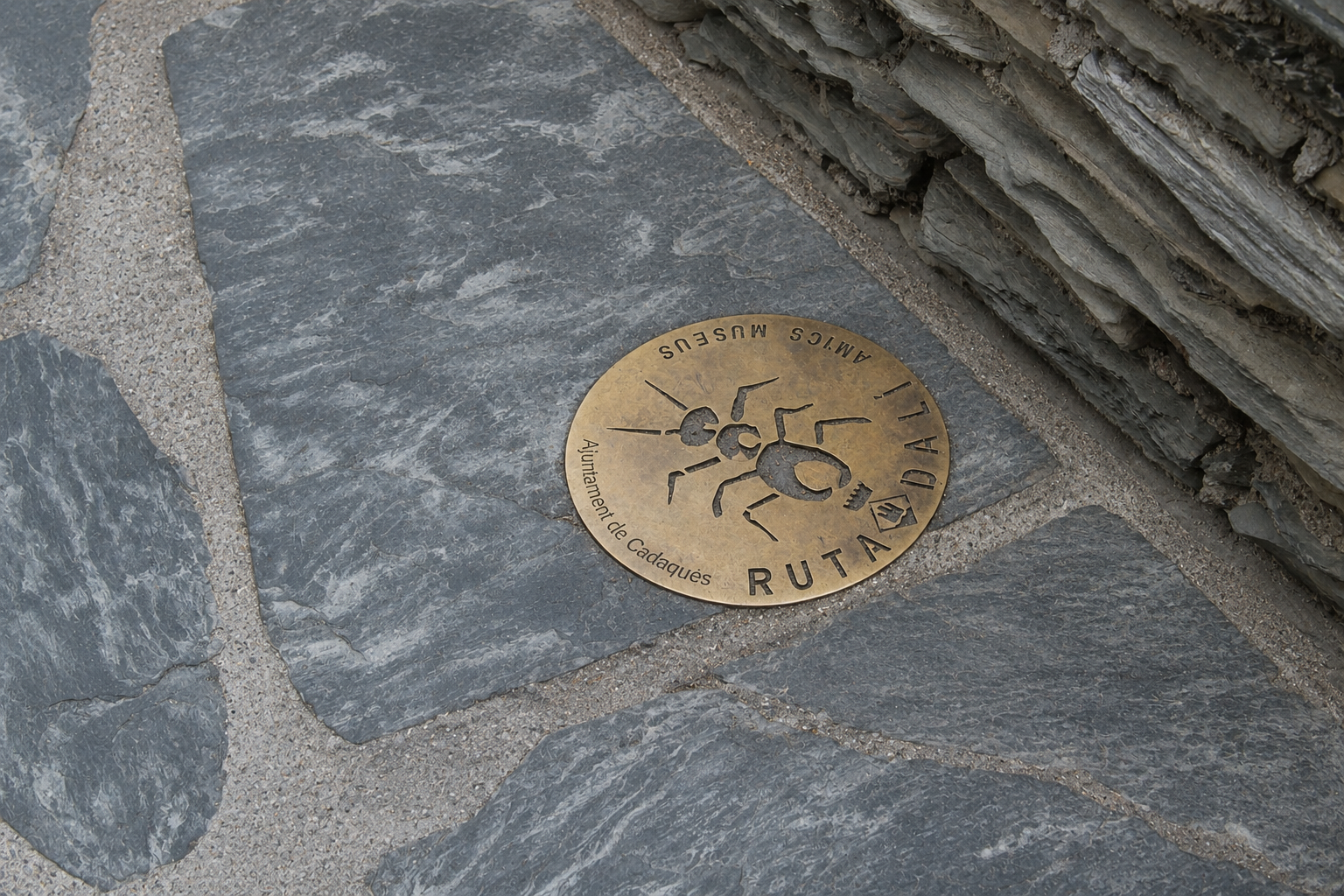
The ants have become the small guides of the route.
There are two types of plaques:
- The ground ants, set into the pavement, mark the route. Their antennae point in the direction to follow.
- The climbing ants, placed at the marked spots, indicate that we are standing before a point of interest related to Dalí.
The plaques were designed by Jordi Palmada. The ground ones are made of brass, about 20 cm in diameter, and the system gives continuity to the Dalí Route that already existed in Figueres.
In this way, the ant stops being merely a symbol within a painting and becomes a footprint on the streets of Cadaqués.
Where do the ants take us?
The route is made up of some thirty places. Among the documented points of the route are:
Sa Conca · Casa Lídia · Monòlit Pitxot · statue of Federico García Lorca · Escala de Sa Cueta and Sa Cueta · Riba d'en Pitxot · Town Hall · sculpture of Dalí on the Beach · Riba des Poal and Casa Picasso · Hort d'en Sanés street · Riba de Portlligat · Corral de la Gala · Cadaqués Museum · Placeta Portal de Mont · Teatre Art i Joia · Societat l'Amistat · the former Hotel Miramar.
Each place tells a different part of the story.
The former Hotel Miramar, for instance, is linked to the meeting of Dalí and Gala. The Llaner area leads us to Federico García Lorca, who visited Cadaqués and stayed there during his sojourns of 1925 and 1927. Riba d'en Pitxot brings us closer to Dalí the painter and to the landscape that appears in his work. And Corral de la Gala recalls a space where Dalí staged some of his performances.
The route also tells us about people who were part of that extraordinary artistic Cadaqués: Gala, García Lorca, Luis Buñuel, Pablo Picasso, Marcel Duchamp, Àngel Planells and the Pitxot family, among others.
Another way of looking at Cadaqués
This is, probably, the most interesting idea behind the ants.
They do not simply take us from point A to point B. They teach us to look.
Cadaqués was landscape, refuge, studio, memory and source of inspiration for Dalí. The little ants scattered through its streets make visible this story that might otherwise go unnoticed.
Following them means gradually discovering that behind a house, a shore, a square or a window there may be a story connected to Dalí.
The ants are small, but the world they invite us to discover is immense.